how does seo work ?
How Does SEO Work? A Complete Guide for Beginners
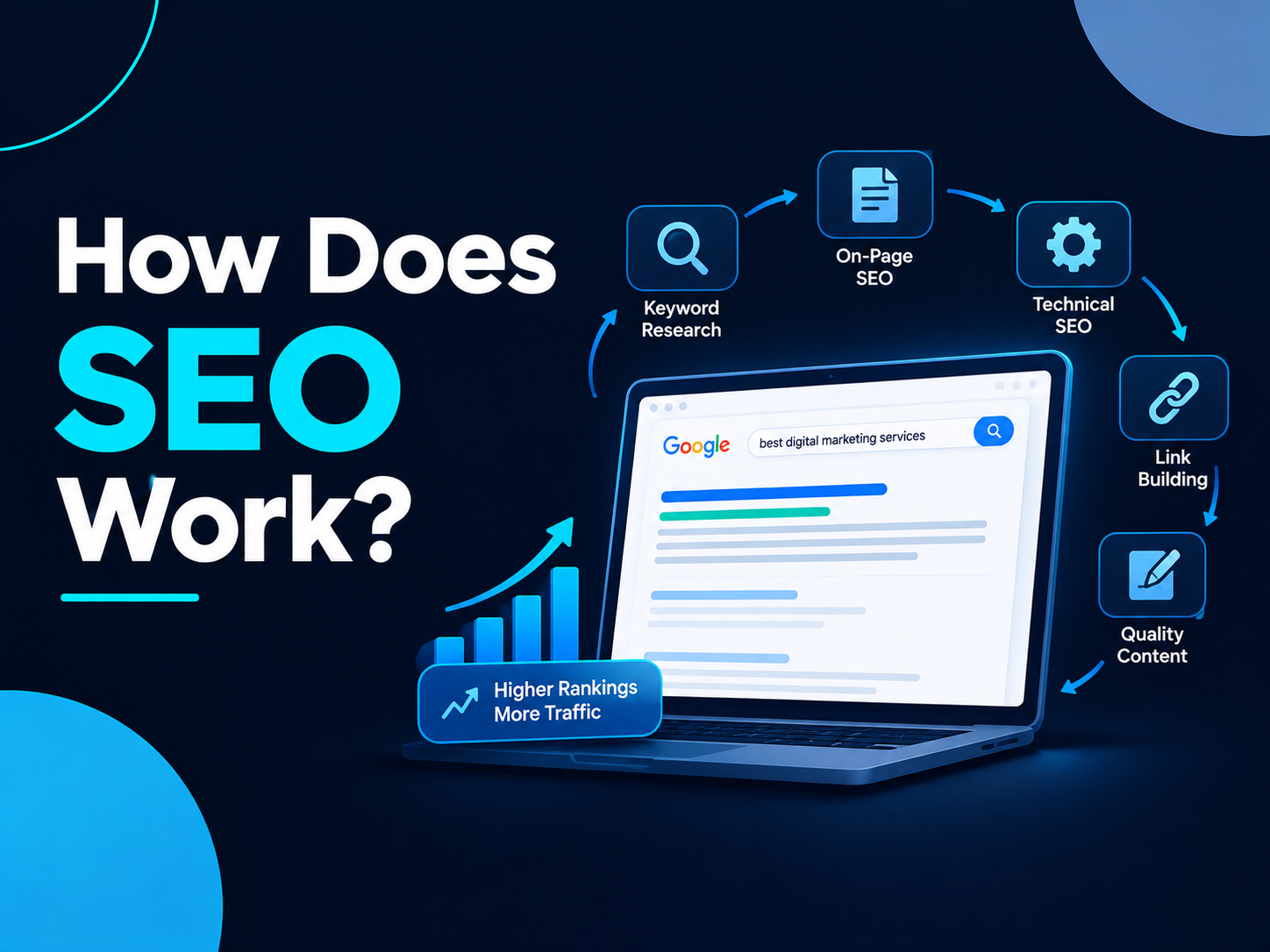
If you are wondering how does SEO work, the simple answer is that SEO helps search engines understand your website and determine whether its pages are useful and relevant to people searching online. Search engine optimisation involves improving your website, content, technical performance, and online authority so that your pages have a better chance of appearing in relevant search results.
SEO is not a one-time activity. It is an ongoing process that requires research, optimisation, quality content, and regular monitoring.
How Does SEO Work?
Search engines such as Google use automated systems to discover, understand, and rank webpages. When someone searches for something, the search engine tries to provide the most relevant and useful results.
SEO helps your website communicate its relevance and quality to search engines. It involves several important areas, including keyword research, on-page SEO, technical SEO, content optimisation, backlinks, and user experience.
1. Keyword Research
Keyword research is one of the first steps in SEO. It involves identifying the words and phrases your target audience uses when searching for information, products, or services.
For example, a business providing web design services in Kannur might target keywords related to web designing, website development, and local web design services.
The goal is not to use keywords repeatedly. Instead, keywords should be incorporated naturally into useful content that matches search intent.
2. Creating Useful Content
Content plays an important role in SEO. Search engines want to provide users with information that answers their questions and satisfies their search intent.
You can create blog posts, service pages, guides, tutorials, product pages, and other useful resources. High-quality content should be accurate, easy to understand, well-structured, and genuinely helpful.
Using headings, short paragraphs, lists, images, and relevant internal links can also make content easier to navigate.
3. On-Page SEO
On-page SEO involves optimising elements on your website. Important areas include:
- Page titles
- Meta descriptions
- Headings
- URLs
- Image alt text
- Internal links
- Keyword placement
- Content structure
These elements help search engines understand what each page is about and help users decide whether the page is relevant to their search.
4. Technical SEO
Technical SEO focuses on the technical aspects of your website that affect search engine crawling, indexing, and user experience.
A technically optimised website should load efficiently, work well on mobile devices, use a logical site structure, and avoid important technical errors.
Other areas can include XML sitemaps, HTTPS, canonical URLs, structured data, and crawlability.
Technical SEO does not replace good content, but poor technical performance can make it harder for search engines and users to access your website effectively.
5. Building Website Authority
Search engines can use signals from other websites to understand the authority and reputation of a webpage.
Backlinks are links from other websites to your website. Relevant, trustworthy backlinks can help strengthen your site’s authority.
However, chasing hundreds of low-quality links is not a good SEO strategy. Focus on creating valuable content that earns genuine mentions and links from relevant websites.
6. User Experience
SEO is ultimately connected to the experience visitors have on your website.
Your pages should be easy to navigate, readable, mobile-friendly, and useful. Visitors should be able to quickly find the information they need.
A website that provides a poor experience can struggle to convert visitors even if it receives search traffic. SEO should therefore be approached as both a search visibility strategy and a website improvement process.
7. Monitoring SEO Performance
SEO requires continuous monitoring. Tools such as Google Search Console and Google Analytics can help you understand how your website is performing.
You can monitor impressions, clicks, search queries, organic traffic, page performance, and technical issues. This information helps you identify what is working and where improvements are needed.
How Long Does SEO Take to Work?
There is no fixed timeframe for SEO results. The time required can depend on competition, website authority, content quality, technical condition, backlinks, search intent, and the age of the website.
Some changes may produce improvements relatively quickly, while competitive keywords can take considerably longer. Sustainable SEO focuses on consistent improvement rather than trying to achieve instant rankings.
Why Is SEO Important for a Business?
SEO can help businesses increase organic visibility and attract people who are actively searching for their products or services.
Unlike relying entirely on paid advertising, SEO can continue generating organic traffic after content and pages have been properly optimised. However, SEO is not completely free. It requires time, research, content creation, technical work, and ongoing optimisation.
For local businesses, local SEO can also help attract potential customers searching for services in a specific area.
Summary
Understanding how does SEO work starts with recognising that SEO is a combination of strategies rather than a single technique. Keyword research, useful content, on-page optimisation, technical SEO, backlinks, user experience, and performance monitoring all work together to improve search visibility.
If you want to improve your website’s search presence and attract more relevant customers, working with a digital marketing strategist in Kannur can help you develop an SEO strategy based on your business goals and target audience.