7 SEO Mistakes Small Businesses Make and How to Avoid Them
7 Costly SEO Mistakes Small Businesses Make and How to Avoid Them
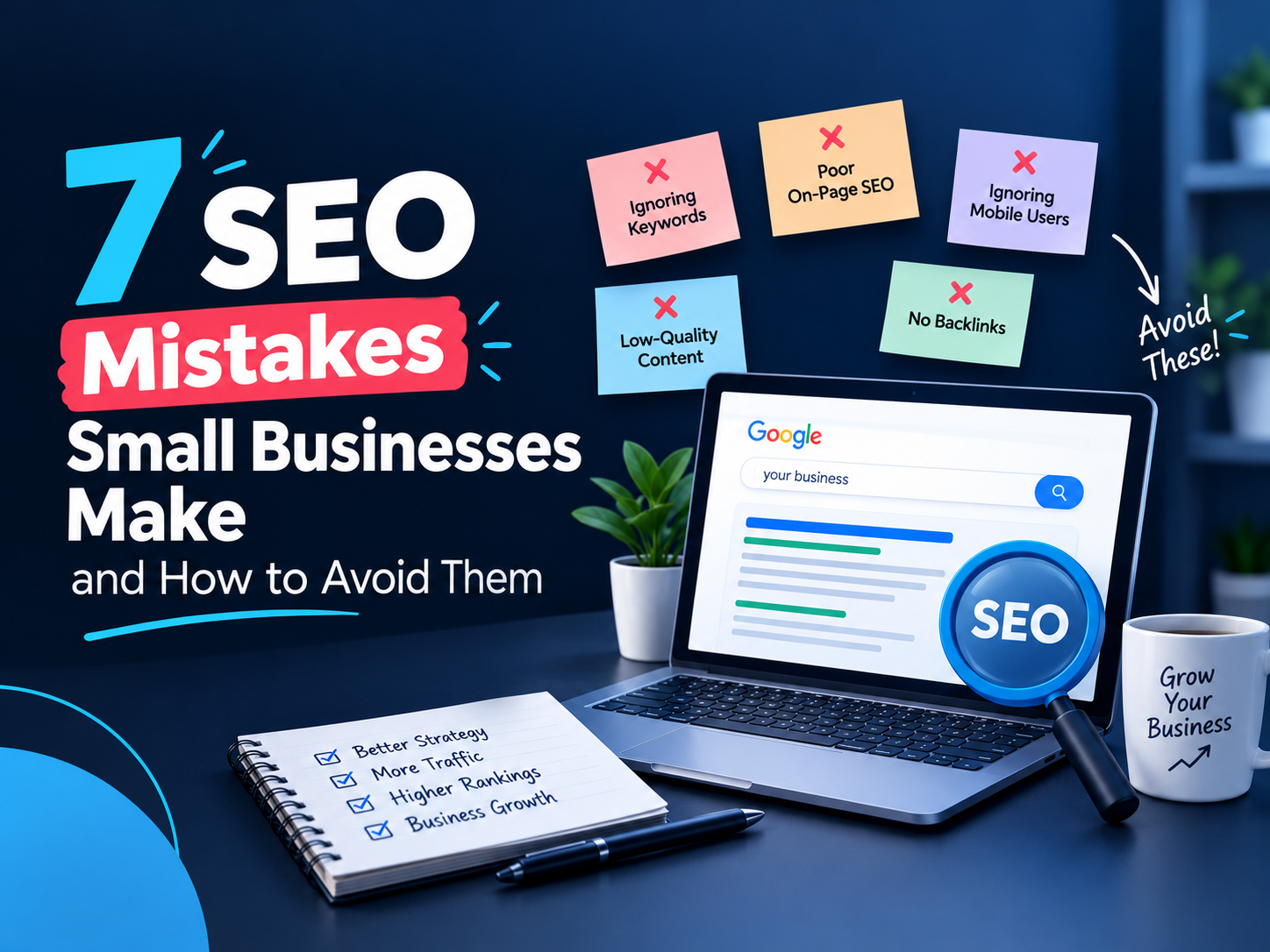
SEO can help small businesses increase visibility, attract potential customers, and generate consistent organic traffic. However, many businesses make simple SEO mistakes that prevent their websites from performing well in search results.
The good news is that most SEO mistakes small businesses make can be identified and corrected with the right strategy. In this guide, we will look at seven common mistakes and explain what you can do to avoid them.
1. Ignoring Local SEO
One of the biggest SEO mistakes small businesses make is ignoring local search optimization.
If your business serves a specific city or area, appearing in local search results can be extremely valuable. Potential customers often search for services using terms such as “SEO services near me,” “web designer in Kannur,” or “digital marketing strategist in Kannur.”
How It Can Hurt Your Business
Without proper local SEO, your business may struggle to appear in relevant local searches and Google Maps results. This can allow competitors to capture customers who are actively looking for your services.
How to Fix It
Focus on:
- Optimizing your Google Business Profile.
- Using relevant local keywords naturally.
- Creating location-specific service pages.
- Keeping your business name, address, and phone number consistent.
- Earning relevant local backlinks.
- Collecting genuine customer reviews.
Local SEO is especially important for businesses that depend on customers from a specific city or region.
2. Creating Thin or Unhelpful Content
Publishing blog posts simply to have more content is another common SEO mistake.
A short article is not automatically bad. The real problem is content that provides little useful information, repeats what other websites have already said, or fails to satisfy the reader’s search intent.
How to Fix It
Before creating an article, ask:
- What is the reader actually searching for?
- What information do they need?
- Can I provide a clearer explanation?
- Can I add examples, original insights, data, or practical steps?
Instead of focusing only on word count, focus on useful, relevant, and well-structured content.
For example, instead of writing a generic article about SEO, create a practical guide explaining how a small business can improve its Google visibility step by step.
3. Keyword Stuffing
Keywords are important for SEO, but repeatedly inserting the same keyword can make your content difficult to read.
For example, writing a sentence such as “the best SEO services in Kannur provide SEO services in Kannur for businesses looking for SEO services in Kannur” is unnatural and provides a poor user experience.
How to Fix It
Use your target keyword naturally throughout the page.
You can also use related phrases and variations that help search engines understand the topic. Focus on writing for people first rather than trying to repeat a keyword a specific number of times.
Your primary keyword should appear in important locations such as:
- Page title.
- Introduction.
- Relevant headings.
- URL.
- Meta description.
- Naturally within the main content.
There is no magic keyword density that guarantees higher rankings.
4. Neglecting Technical SEO
You can publish excellent content and still struggle with SEO if your website has technical problems.
Common technical SEO issues include:
- Slow-loading pages.
- Poor mobile usability.
- Broken internal links.
- Missing or incorrect metadata.
- Indexing problems.
- Poor website structure.
- Unoptimized images.
How to Fix It
Regularly check your website using tools such as Google Search Console and PageSpeed Insights.
Pay attention to indexing, mobile usability, Core Web Vitals, broken links, and other technical issues that can affect the user experience and search visibility.
Technical SEO does not need to be complicated, but ignoring it can create unnecessary problems.
5. Building Low-Quality Backlinks
Backlinks can help establish your website’s authority, but buying large numbers of low-quality links is not a sustainable SEO strategy.
Services promising thousands of backlinks for a very low price should be treated with caution.
How to Build Better Backlinks
Focus on earning relevant links through:
- Useful resources.
- Industry publications.
- Genuine guest contributions.
- Local business directories.
- Partnerships.
- Original research.
- Shareable content.
The goal should not be to collect as many backlinks as possible. The goal is to earn relevant and trustworthy links that make sense for your business.
6. Focusing Only on Rankings and Traffic
Another common SEO mistake is measuring success only through keyword rankings or website traffic.
Traffic is useful, but it does not automatically mean your SEO strategy is generating business.
A better approach is to monitor metrics such as:
- Organic clicks.
- Search impressions.
- Click-through rate.
- Leads.
- Contact form submissions.
- Phone calls.
- Sales or enquiries.
- Conversions from organic traffic.
For example, 1,000 visitors who are not interested in your services may be less valuable than 100 visitors who are actively looking for what your business offers.
SEO should ultimately support business growth, not just produce impressive numbers in an analytics report.
7. Giving Up on SEO Too Quickly
SEO is not an overnight marketing strategy.
One of the biggest SEO mistakes small businesses make is expecting major results within a few weeks and abandoning the strategy when rankings do not immediately improve.
The time required to see results depends on factors such as competition, website authority, content quality, technical condition, search intent, and the SEO strategy being implemented.
How to Fix It
Instead of expecting instant results, monitor progress over time.
Look for smaller improvements such as:
- More search impressions.
- Higher rankings for target keywords.
- Increasing organic clicks.
- Better click-through rates.
- More indexed pages.
- More enquiries from organic search.
These indicators can help you understand whether your SEO strategy is moving in the right direction.
How Small Businesses Can Avoid SEO Mistakes
Avoiding SEO mistakes starts with having a clear strategy.
Before publishing content or building backlinks, understand your target audience, research relevant keywords, analyze competitors, improve your website structure, and create content that genuinely answers customer questions.
For local businesses, combining local SEO, useful content, technical SEO, and a strong Google Business Profile can create a much stronger foundation for long-term organic growth.
Conclusion
The most damaging SEO mistakes small businesses make are often not complicated. Ignoring local SEO, publishing unhelpful content, stuffing keywords, neglecting technical SEO, building low-quality backlinks, tracking the wrong metrics, and giving up too early can all limit your website’s potential.
The solution is not to chase every SEO trend. Build a strong foundation, create useful content, optimize your website for search engines and users, and consistently monitor your results.
If you are a business owner looking to improve your online visibility, connect with a digital marketing strategist in Kannur to develop an SEO strategy based on your business goals, target audience, and local market.
Ready to improve your website’s SEO performance? Book a consultation today and take the first step towards growing your business online.

Muhammed Nisan vp
Muhammed Nisan VP is a digital marketing strategist and web designer specializing in SEO, social media marketing, Meta Ads, Google Ads, and WordPress website development. Passionate about helping businesses grow online, he creates data-driven marketing strategies and high-performing websites that enhance brand visibility, generate leads, and drive measurable results. He also shares insights on digital marketing, SEO, web development, and emerging technologies to help businesses succeed in the digital world.